
K-GRID offers fish farmers predator protection and less biofouling
By Chris Loew • Published: September 13, 2025
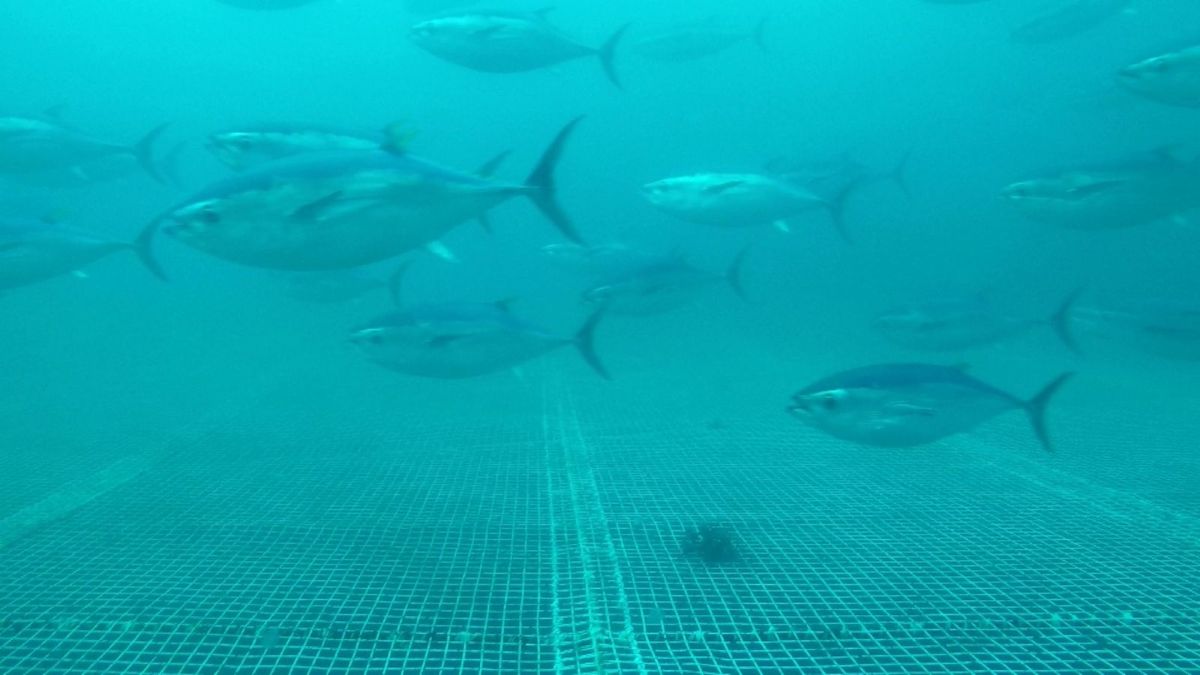
Kinoshita Fishing Net Mfg. Co. Ltd. (based in Nishio City, Aichi Prefecture) displayed its patented K-GRID ultra-high-stiffness net at the 27th Japan International Seafood & Technology Expo, held 20–22 August. The semi-rigid netting has proven effective at Tasmanian salmon farms against seals and sea lion predation, and at barramundi farms in the north of Australia against crocodiles.
K-GRID is a heat-treated version of the company’s muketsu (knotless) netting. In knotless netting, the strands are woven rather than knotted at the crossing points, resulting in a smoother surface that is less abrasive to fish that rub against it. It also presents fewer crevices for biofouling organisms to gain a foothold and is easier to wash than knotted nets.
K-GRID is a square net heat-treated at 170–180 degrees Celsius. The surface strands become plasticized, so it has high resistance to friction and cutting, while the core remains flexible to resist breaking. The stiff, flat netting prevents the predators from getting it into their mouths and ripping it—so it prevents fish escapes.
Company director Mitsunori Kimura said, “In Japan, sea lions are not a big problem, but shark predation is increasing, as the ocean around Japan has been getting warmer.” He also said that net pens made with K-GRID also retain their shape in rough water, while normal netting deforms and crowds the fish, which stresses the fish and results in more rubbing against the pen walls. This is important in Japan, which experiences annual typhoons.
However, an issue that arises with the semi-rigid panels is how to crowd the fish for harvest. At the show, the company displayed a model of a jointed aquaculture cage that could be drawn up by ropes to within two meters of the surface. Kimura said that a regular flexible net can also be inserted inside the cage at harvest time.
K-GRID is much lighter than copper netting, which is also promoted for toughness against predators. Deploying and retrieving copper netting often requires heavy-lift cranes. The cost of copper netting is several times that of either K-GRID or conventional mesh pens. This is offset over time by reduced labor spent on maintenance, as copper has natural anti-fouling properties. However, Kinoshita Fishing Net Mfg. Co., Ltd. has introduced a new version treated with cuprous oxide as an anti-fouling agent. Kimura said that the anti-fouling is effective for about 5 years before the net has to be raised, dried and retreated.
Kinoshita worked with Unitika (Osaka) to develop the mesh yarn for K-GRID. The core is high-viscosity polyester fiber, while the outer part is a low-melting co-polymer polyester. Unitika conducted weather-resistance tests using the Sunshine Weather Meter method and found that the material will retain over 90 percent of its strength even after 20 years.
Kinoshita weaves the net and performs the heat treatment. A company in Vietnam assembles the netting into pens and these are then shipped to customers. Kimura said that a few customers will construct their own pens. The product has found the most success in Australia, where they are sold through Nets Tasmania Pty Ltd. While Australia has been the main market so far, approximately 250 units have been installed worldwide, including in Japan, South Korea, Canada, Chile, Turkey, and Greece.