
Japan export data show shift in scallop processing
By Chris Loew • Published: February 17, 2026
Japan’s Ministry of Agriculture, Forestry and Fisheries (MAFF) announced on 3 February that exports of agricultural, forestry and fishery products in calendar year 2025 reached JPY 1.7 trillion (USD 11.36 billion or EUR 10.08 billion), up 12.8 percent year-on-year in yen terms. Fishery products accounted for JPY 423.1 billion of that total, an increase of 17.2 percent from 2024.
Scallops remained the largest single contributor to seafood export value.
Trade statistics published by Japan Customs and the Ministry of Finance (MoF) shows that frozen scallop exports (HS code 0307.22) totaled 15.7 million kilograms in 2025, with a customs value of JPY 68.0 billion (USD 454.24 million, EUR 403.08 million).
That compares with 16.00 million kg valued at JPY 49.4 billion in 2024 (USD 326.14 million, EUR 301.40 million); 15.83 million kg valued at JPY 38.5 billion in 2023 (USD 273.29 million, EUR 252.40 million); and 14.44 million kg valued at JPY 43.1 billion in 2022 (USD 327.76 million, EUR 312.07 million). Currency conversions are given using the average exchange rate for each year.
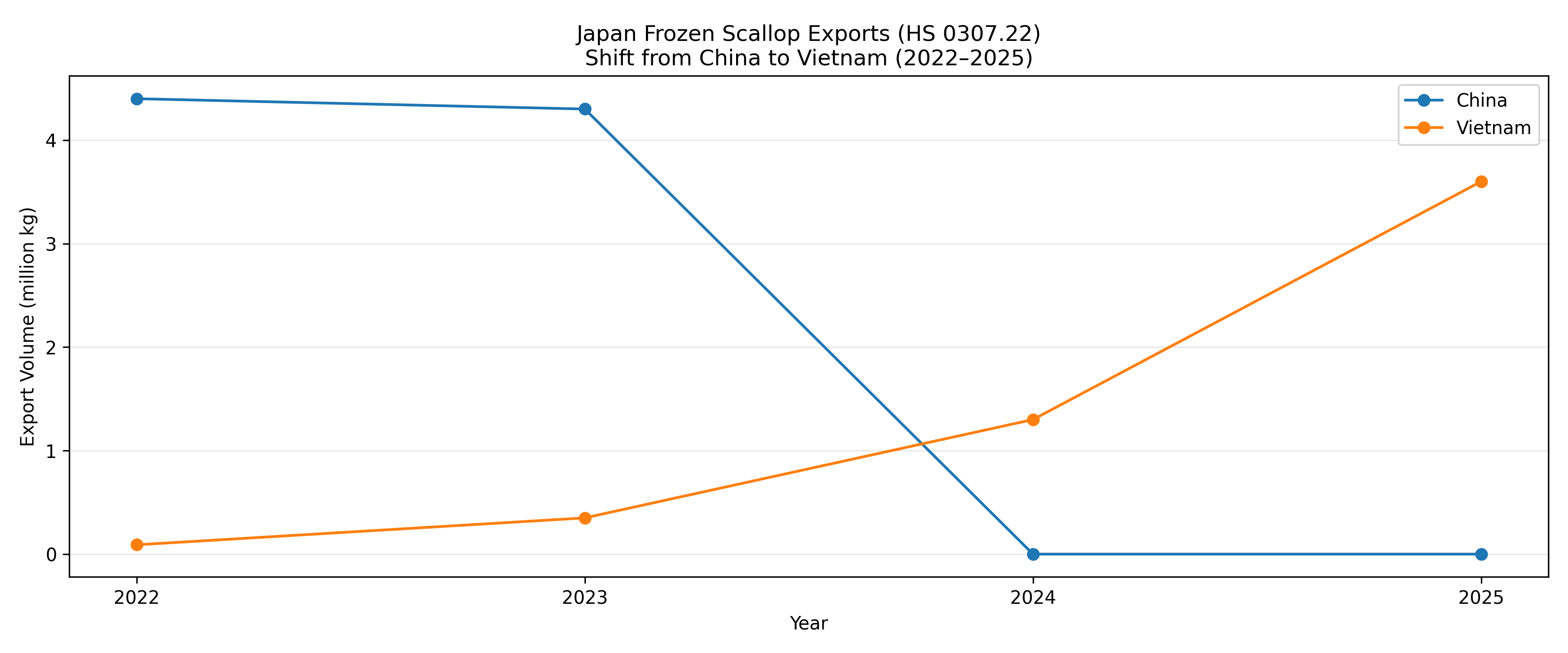
While overall volumes changed little, the destinations shifted markedly following China’s August 24, 2023 ban on Japanese seafood imports.
In 2022, Japan exported 4.4 million kilograms of frozen scallops to China. Shipments remained above 4.3 million kilograms in 2023 before falling to zero in 2024 and 2025. Over the same period, exports to Vietnam increased from 94,000 kilograms in 2022 to 1.3 million kilograms in 2024 and 3.6 million kilograms in 2025. Taiwan and Hong Kong remained important destinations, but neither exhibited growth comparable to Vietnam.
| Year | Volume (kg) | Exports to China (kg) | Exports to Vietnam (kg) |
|---|---|---|---|
| 2022 | 14.4 M | 4.4 M | 0.09 M |
| 2023 | 15.8 M | 4.3 M | 0.35 M |
| 2024 | 16.0 M | 0 | 1.3 M |
| 2025 | 15.7 M | 0 | 3.6 M |
Source: Japan Ministry of Finance (MoF) trade statistics (HS 0307.22).
The data indicate a reconfiguration of export routes rather than a collapse in total trade volume.
Unit values reflect a similar pattern. Based on MoF data, frozen scallop export values averaged approximately JPY 2,986 per kg in 2022. That figure declined to roughly JPY 2,430 per kg in 2023, before recovering to JPY 3,084 per kg in 2024 and rising further to approximately JPY 4,320 per kg in 2025.
Part of the increase reflects yen depreciation over the period. The yen weakened from roughly 131 per dollar in 2022 to approximately 150 per dollar in 2024–2025. However, even after adjusting for exchange rate effects, the 2024–2025 recovery represents a material rebound from the 2023 trough.
China’s role prior to the ban extended beyond end-market consumption. A February 2024 US International Trade Commission Executive Briefing on Trade noted that Japanese scallops were frequently shipped to China for processing and subsequent re-export. The report stated that replacing processing capacity would likely prove more difficult than finding alternative buyers.
Japan briefly examined options—including using prison labor and installing automatic shucking machines—to expand domestic processing capacity in late 2023, but no large-scale structural shift occurred within Japan. The prison labor would have run afoul of US rules on imports, and the machines are custom ordered with lead time of about a year.
MoF data for prepared scallops (HS 1605.52) show that exports declined from 4.2 million kilograms in 2022 to 2.1 million kilograms in 2025, indicating that Japan did not significantly expand domestic value-added processing during the period.
Instead, frozen exports to Southeast Asia increased.
Vietnam’s rapid rise as a destination aligns with a shift in processing of frozen shell-on scallops from China to Vietnam, for ultimate export mainly to the USA. Frozen scallop exports to Vietnam expanded more than thirty-fold between 2022 and 2025.
US import data from the International Trade Commission support the view that Vietnam emerged as third-country processing base in 2024. US imports of frozen scallops (HS 0307.22) from Vietnam increased from 16,934 kilograms in 2023 to 365,392 kilograms in 2024. By comparison, US imports from Japan declined in 2023 before recovering in 2024 to 8.9 million kilograms. US data for 2025 has not yet been released.
The United States also took steps to support Japan’s seafood sector following the ban. Reuters reported in October 2023 that the US military began purchasing Japanese seafood for consumption at US bases in Japan. The US Ambassador to Japan at the time, Rahm Emmanuel, also referred Japan to US-registered processing facilities capable of exporting to the United States. While the precise commercial impact of those measures is difficult to quantify, US import data show that trade flows continued and, in some cases, expanded through alternative channels in 2024.
Taken together, the data show that Japan’s scallop sector adjusted through geographic reallocation rather than contraction.
Total frozen export volumes in 2025 were broadly comparable to pre-ban levels. Export values reached record highs in yen terms, supported by both price recovery and currency effects. The primary structural change was the disappearance of China as a processing and import hub and the concurrent rise of Vietnam as a significant destination for frozen product.